Glacial Ice and Dynamics
.Bd67zIuW_12iF5X.webp)
GLACIERS & TERRAIN: THE ARCHITECTS OF LANDSCAPE
A glacier must never be conceptualized merely as static geometry, but as a metamorphic rock that behaves like a high-viscosity fluid. It flows under the influence of gravity, fractures under tension, and polishes mountain ranges into distinctive shapes. To build a believable environment, one must understand the scale of these systems and the specific shape language they carve into the earth.
Visualizing glacial environments with ice as a uniform white mass that lacks any detail is a common mistake. In reality glacial ice is defined by density gradients and stress history that will shape the landscape. It possesses a core of compressed and transmissive blue ice and a “skin” of porous weathering crust. It is a dynamic system of immense energy moving in slow motion.
THE ANATOMY OF AN ICE BODY
Glacial bodies are classified primarily by their relationship to the underlying topography. The scale varies by orders of magnitude, and the visual language changes drastically whether you are rendering a continental sheet or a constrained mountain stream.
CONTINENTAL ICE SHEETS
The largest forms of glacial ice are the Ice Sheets, currently found only in Antarctica and Greenland. These are continental-scale domes that obscure the underlying land entirely. An ice sheet shows an endless white horizon and is a “desert of ice”. The scale is often difficult to comprehend due to the lack of reference points. The ice flows outward from the center of the dome towards the ocean and is unconstrained by any valleys until it reaches the periphery.
The monotony of an ice sheet is broken up only by Nunataks, which are isolated peaks of bedrock that poke through the ice.
ICE CAPS AND VALLEY GLACIERS
Ice Caps are smaller than ice sheets. They are dome-shaped masses that sit on top of plateaus, such as Vatnajökull in Iceland. Unlike valley glaciers (which are constrained by topography), ice caps flow radially outward from a central high point. One can identify them through the contrast between the white dome of the accumulation zone and the dirty and crevassed tongues of the outlet glaciers that spill down from the main dome like fingers.
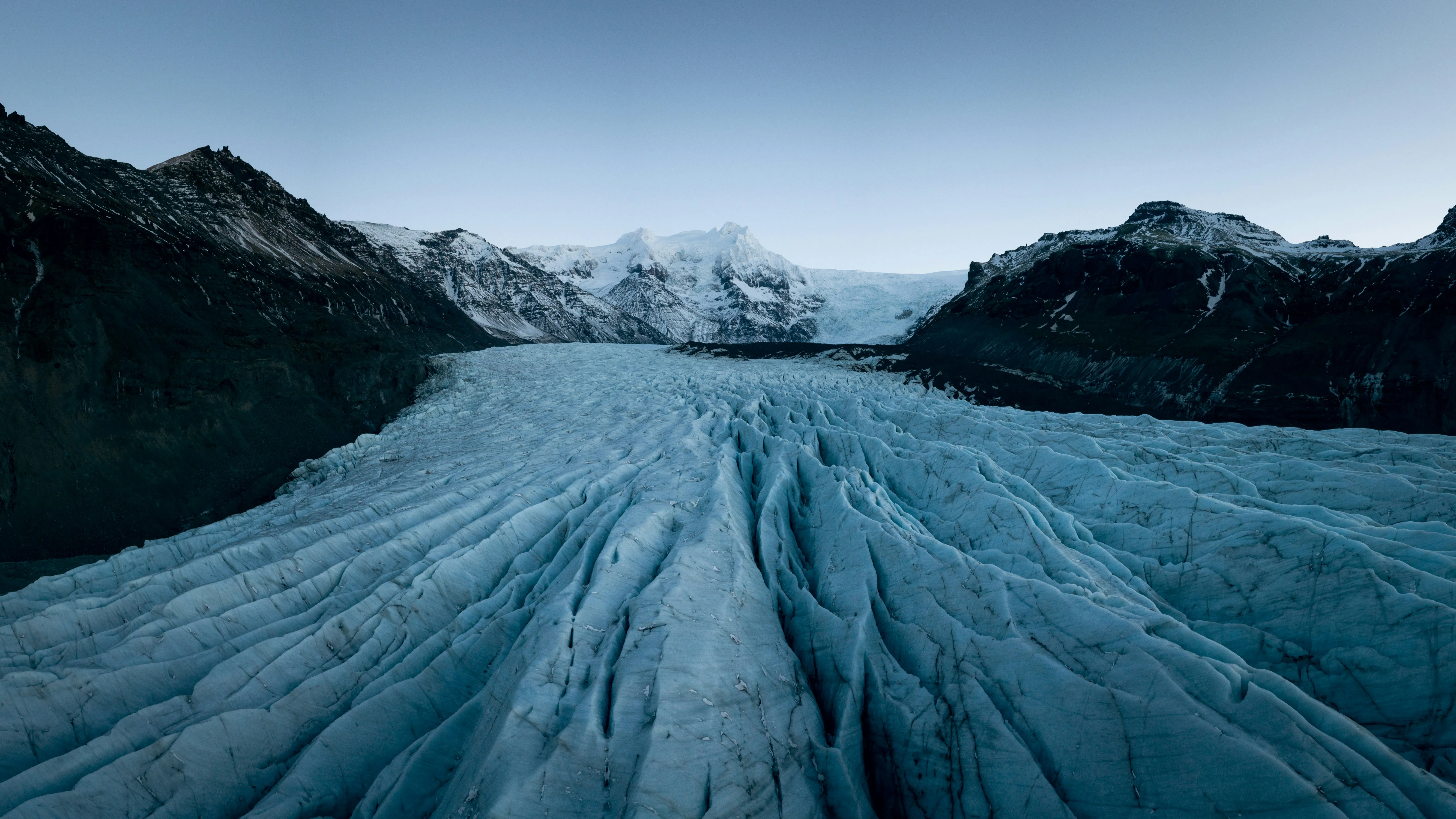
Valley Glaciers are streams of ice that is constrained by mountain walls, and which is flowing down a valley like a slow river. Because they are confined, they exhibit complex flow dynamics that result in heavy surface texturing. Friction against the valley walls creates shear stress, while the center of the glacier flows faster. Every line, streak and crack on its surface needs to follow the direction of flow (or stresses resisting it).
PIEDMONT GLACIERS
When a constrained valley glacier flows out of a steep mountain range and spills onto a flat plain, a Piedmont Glacier is formed. Since it is no longer confined by valley walls, the ice spreads out radially and is creating a perfect bulbous fan or lobe shape.
The debris is twisted from linear Medial Moraines into complex folds, which visualizes the fluid dynamics of the ice over centuries.
BLUE ICE & WEATHERING CRUST
To render a glacier realistically, one must abandon the idea of a solid white block, it rather is a stratified material with distinct properties determined by density and age.
BLUE CORE ICE
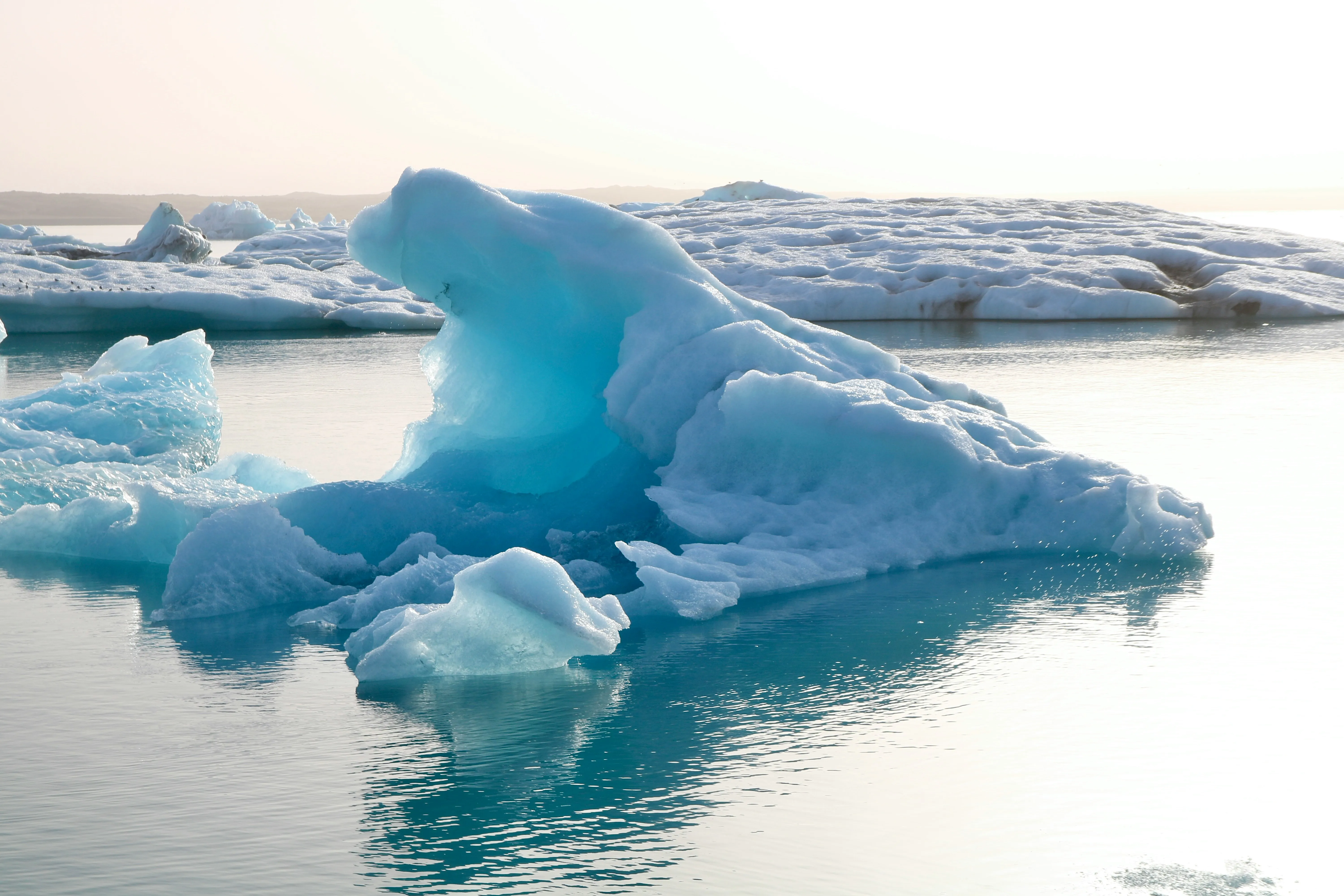
The saturated blue color of deep glacial ice is due to a combination of Rayleigh Scattering and the absorption coefficients of the water molecule. Dense, bubble-free ice absorbs red light and scatters blue light. The deeper you look into a glacier (especially crevasses, moulins, or freshly calved icebergs), the more electric the blue hue becomes. It is not a surface pigment but a volumetric effect.
WEATHERING CRUST
Glaciers are rarely uniform blocks of glass since solar radiation degrades the surface into a porous Weathering Crust. That means we have a opaque white layer acts as a diffuse skin on top of the transmissive blue core. The deep blue ice should only be visible where the crust has been fractured.
1.4 FLOW MECHANICS & FRACTURE PATTERNS
A glacier moves through two primary mechanisms: Plastic Flow (smooth deformation deep inside) and Brittle Fracture (surface cracking). The ice at depth flows similar to a visuous honey, but the top surface is brittle. When the ice stretches faster than it can deform, it cracks, and these cracks are called Crevasses.
CREVASSE MORPHOLOGY
| Type | Stress Mechanism | Look |
|---|---|---|
| Transverse Crevasses | Acceleration. Occurs when the slope steepens, stretching the ice longitudinally. | Deep, parallel cracks running horizontally across the flow. Look like stretch marks. |
| Longitudinal Crevasses | Widening. Occurs when the valley expands so that the ice is spreading sideways. | Cracks running parallel to the flow direction. Looks like the glacier got “combed”. |
| Chevron Crevasses | Friction. Caused by the drag of the ice against the static valley walls. | Diagonal, saw-tooth cracks angling 45° upstream. Resembling a herringbone pattern. |
| Bergschrund | Separation. The “master crack” at the head of the glacier. | Massive, deep fissure separating the moving ice body from the stagnant mountain face. |
SERACS AND ICEFALLS
When a glacier flows over a steep cliff, the ice cannot stretch fast enough to stay together, and thus it shatters completely and creates an Icefall. This area is full of Seracs, which are towering blocks of ice (often the size of buildings).
OGIVES
Contrary to crevasses which show where the ice broke, Ogives show how it flows. They appear below icefalls as curved bands pointing downstream and act as seasonal markers: Wave Ogives form physical swells and troughs on the surface, while Band Ogives form alternating stripes of clean winter ice and dirty summer ice. They look like the growth rings of a tree, with the distance between two bands representing exactly one year of movement.
1.5 SURFACE TOPOGRAPHY
The surface of a glacier is sculpted by the interplay of sun, wind, water, and debris. These features provide high-frequency detail that makes a glacial environment look authentic.
In high and dry altitudes like the Andes, the sun sublimates the ice rather than melting it. This process is carving deep canyons and is leaving behind tall, thin blades of ice known as Penitentes, and they can grow over 5m tall. In other conditions, uneven melting creates Sun Cups. They have a reticulated honeycomb pattern of concave basins that looks like a cellular noise on the snow surface.
Debris also plays a major role in sculpting the ice. Dark dust absorbs heat and melts itself vertically into the glacier. These holes are called Cryoconite Holes and are basically waterfilled cylinders with black sediment at the bottom. Contrary, thick debris insulates the ice. So instead the surrounding surface melts, and the protected ice remains. This process is forming Dirt Cones, which are pyramids of ice capped with gravel.
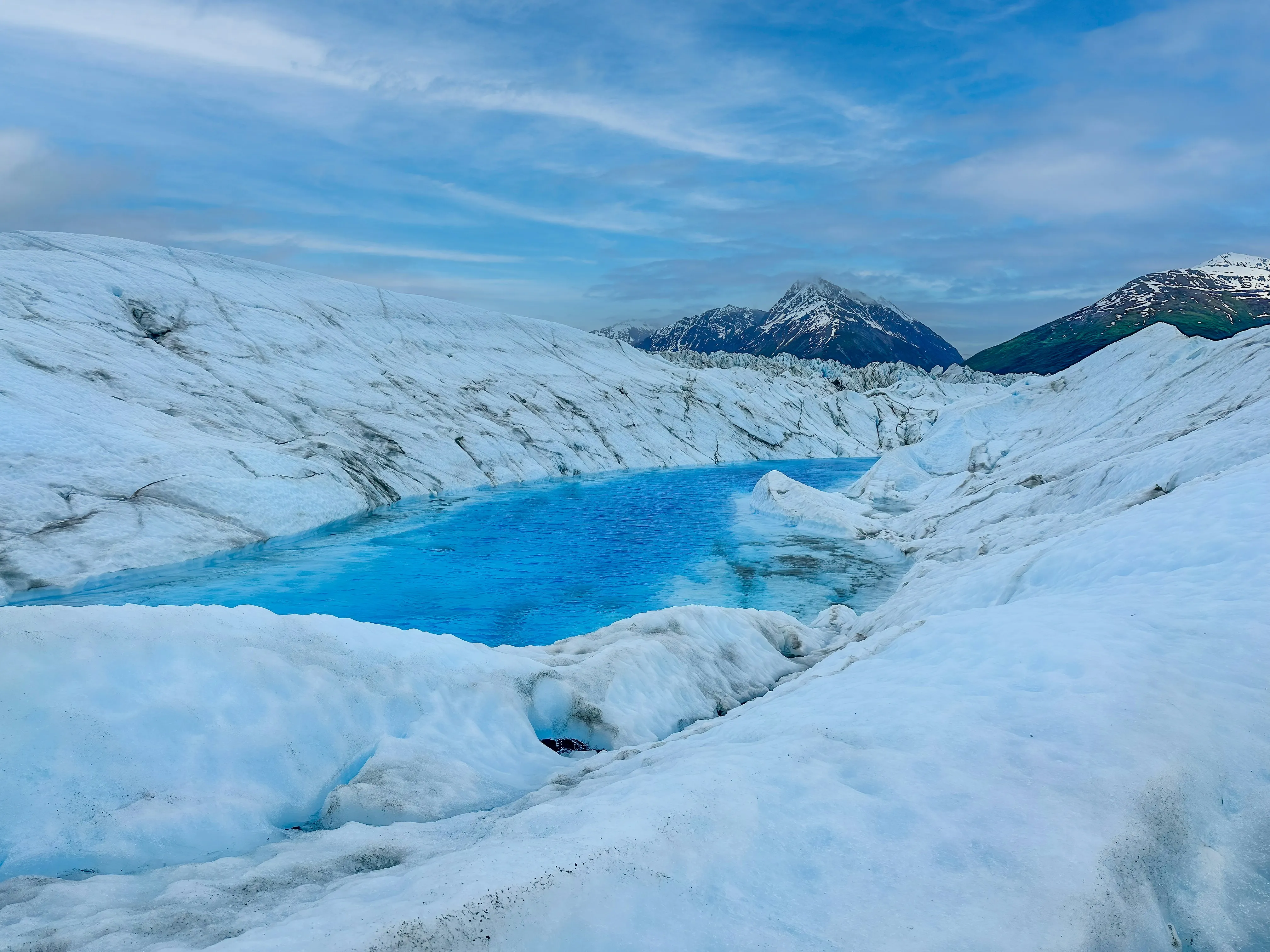
A glacier also has its own drainage system. Supraglacial Lakes pool on the surface, and they’re glowing with a saturated turquoise color against the white ice beneath it. These lakes drain into Moulins, which are vertical shafts that act as drains, and are plunging meltwater into the glaciers interior.
SPECIAL PHENOMENA
Beyond the standard anatomy of glaciers, the cryosphere hosts rare and visually very interesting phenomena that add depth and “coolness” to any depiction of the environment.
At the terminus of the Taylor Glacier in Antarctica you can see Blood Falls. This is an outflow of hypersaline brine rich in ferrous iron. When the clear brine reaches the surface and contacts atmospheric oxygen, the iron instantly oxidizes, which is then turning the water blood-red.