Water and Ice Systems
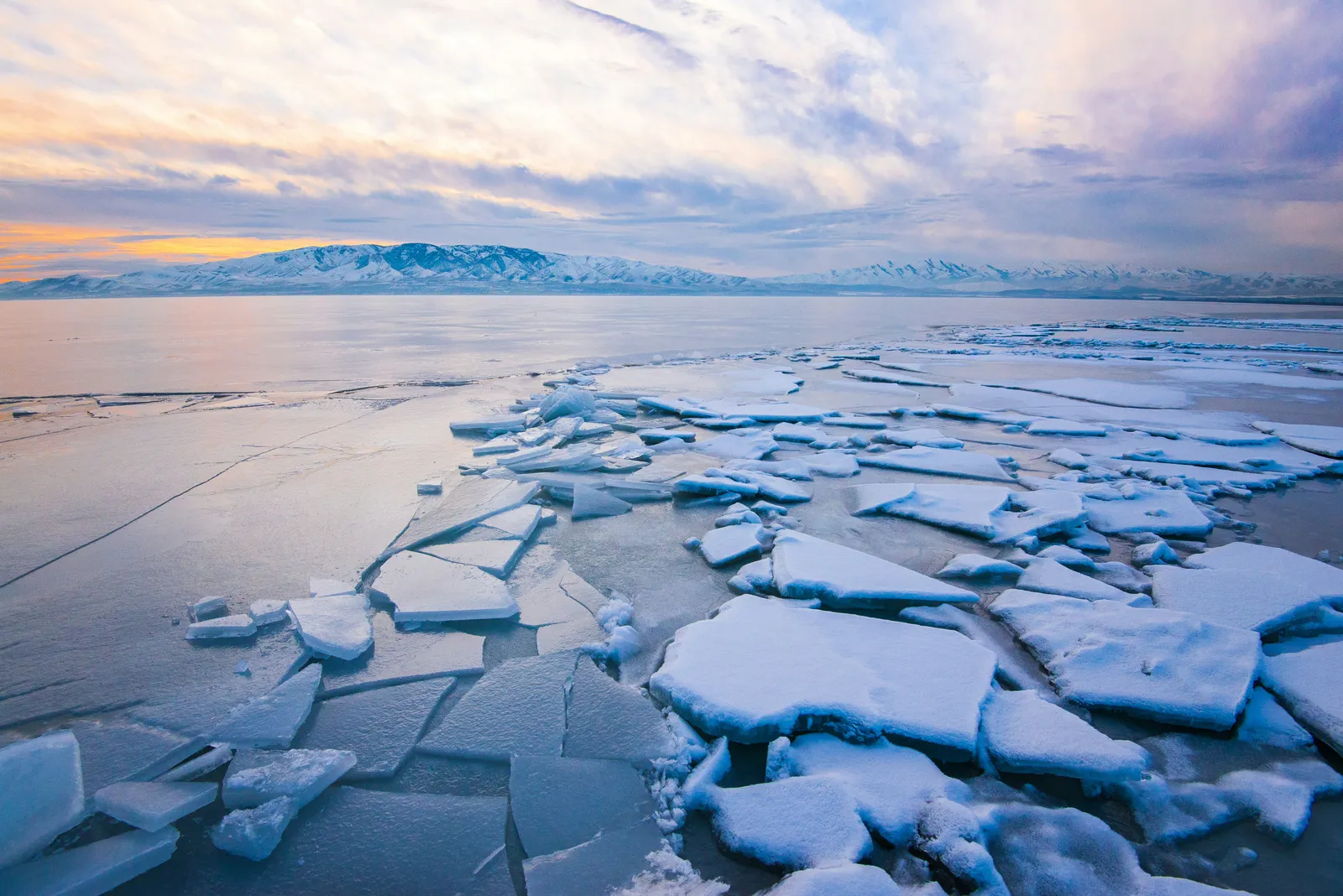
Water Ice Systems - The Aqueous Cryosphere
This chapter explores the aqueous cryosphere, where water transforms into a material that is a brittle solid that floats on its own liquid and which defining variable is Salinity.
Freshwater freezes at 0°C and it forms stable, glass-like sheets. Seawater, however, freezes at -1.8°C, and is rejecting salt.
Sea Ice
Sea ice grows in a specific sequence, evolving from a soup of tiny crystals into huge tectonic plates capable of crushing ships.
The Genesis Sequence
The formation of sea ice depends on how rough the water is. In the open ocean, ice starts as Frazil Ice (tiny “needles” floating in the water). This creates a thick slush that dampens wave energy and makes the ocean surface move less.
As these crystals float to the top they form Grease Ice, which is greyish film that smooths out small ripples and bends with the ocean movement.
- Rough Conditions (Pancake Ice): If the waves are strong the slush clumps together. Constant collisions smash the edges of these clumps and forming them into round discs with raised rims, known as Pancake Ice.
- Calm Conditions (Nilas): If the water is still, the slush freezes into a continuous sheet called Nilas. Because its thin crust bends easily, compression can cause Finger Rafting (sheets slide over each other in an zipper-like pattern).
Consolidation and Rigidity
As the ice thickens into “First-Year Ice” (~30–120cm) it loses its flexibility and becomes brittle. Now when sheets collide, they shatter and stack up, which is forming Pressure Ridges.
First-year ice is salty and relatively flat, while Multi-year ice has survived a summer melt, which washes out the salt, causing a change in material. It becomes harder, fresher and gets a deeper blue color together with a smoothed surface featuring melt ponds.
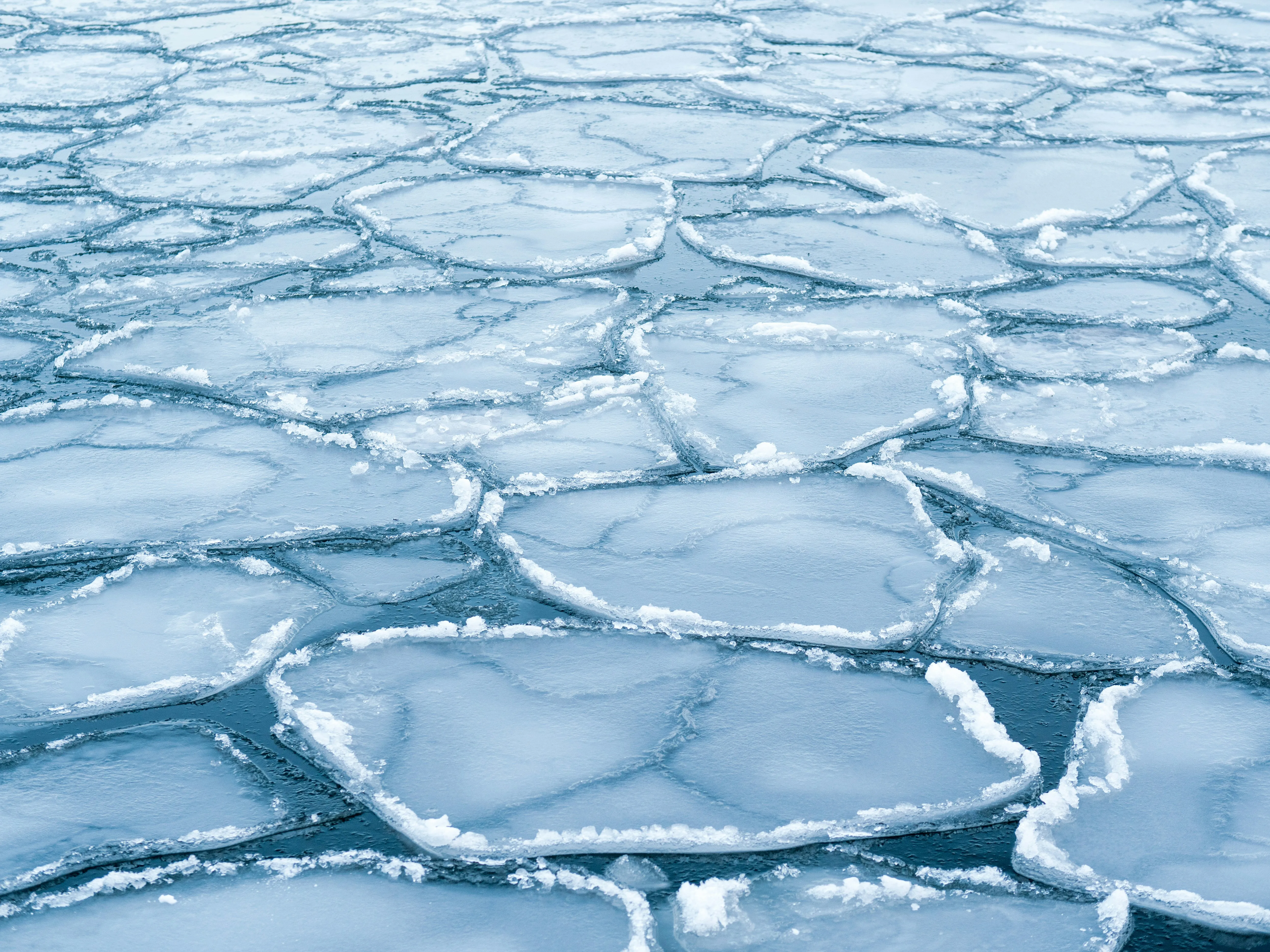
3.3 Surface & Sub-Surface Phenomena
The boundary where the ocean meets the air is a site of constant change.This unique environment breeds fragile, short-lived crystal formations that add a layer of complex micro-detail to the frozen ocean.
Frost Flowers
These are among the most beautiful features of the polar oceans. Frost Flowers appear as fields of fern-like crystals growing on the surface of newly formed ice. They act as wicks and draw salt-rich brine from the porous ice up into their structure.
Dragon Skin Ice
In rare events driven by extreme winds (often in Antarctica), the freezing surface is continuously shattered and blown downwind. This slush stacks up against other floes, causing them to freeze and form overlapping plates.
The Brinicle (“Finger of Death”)
When extremely salty brine drains from the sea ice, it sinks rapidly because it is denser than the surrounding seawater. However, this brine is also colder than the freezing point of the water it passes through. As the plume descends, it freezes the water around it, creating a hollow tube of ice called a Brinicle. If it reaches the seafloor, it spills a river of supercooled liquid that instantly freezes starfish and urchins in its path.
Icebergs
Fundamentally different from sea ice since they are freshwater bodies broken off from glaciers, and they consist of compacted snow (firn) and ancient ice.
Classification and Shape
Tabular bergs are flat-topped islands that calve from floating ice shelves. Non-Tabular bergs encompass all other shapes including “Pinnacles” (spires), “Domes” (rounded tops), and “Drydocks” (U-shaped channels eroded by waves).
The Chromatics of Ice
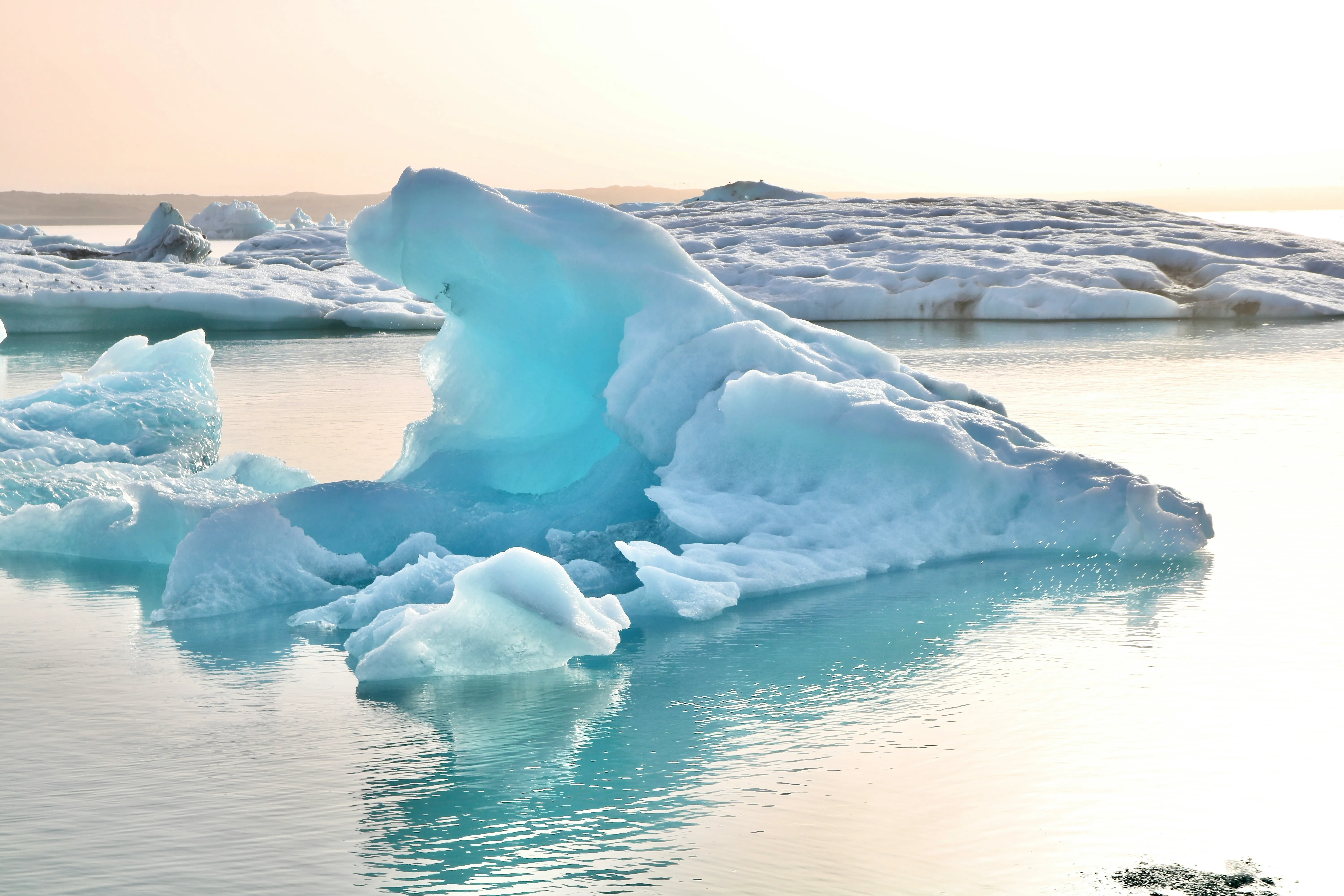
While most icebergs appear white due to air bubbles scattering light, specific circumstances create unique color palettes.
| Color | Origin | Mechanism |
|---|---|---|
| Glacial Blue | Formed deep within the glacier where pressure squeezes out all air bubbles. | Dense and bubble-free ice absorbs red light which makes them appear electric blue. |
| Jade Icebergs | Seawater freezes to the underside of an ice shelf and tras organic matter. | The yellow tint of dissolved organic carbon mixes with the natural blue of the ice to produce a translucent emerald or jade green. |
| Stripes | Cracks in the glacier fill with liquid and refreeze. | Blue Stripes: Refrozen freshwater. Green/Brown Stripes: Seawater rich in algae or sediment. |
Rollover and Scalloping
As icebergs melt their center of gravity shifts, which will cause them to flip after a while. The underside of an iceberg is glassy, smooth, and covered in Ablation Hollows, which are concave depressions carved by turbulent water currents. It looks similar to the patterns found on meteorites.
Freshwater: Lakes & Rivers
Freshwater ice lacks the salt of the ocean so it is harder and clearer than the porous sea ice.
| Type | Formation | Look |
|---|---|---|
| Black Ice (Congelation) | A single crystal grows downward in still water. | Perfectly transparent but appears black because it reveals the dark water depth beneath. |
| White Ice (Snow Ice) | Snow falls on the sheet, is flooded by water, and refreezes. | Opaque, granular, and white. Lacks transparency of black ice. |
| Candle Ice (Rotten) | Spring sunlight melts the boundaries between vertical crystals. | The sheet disintegrates into loose vertical shards. |
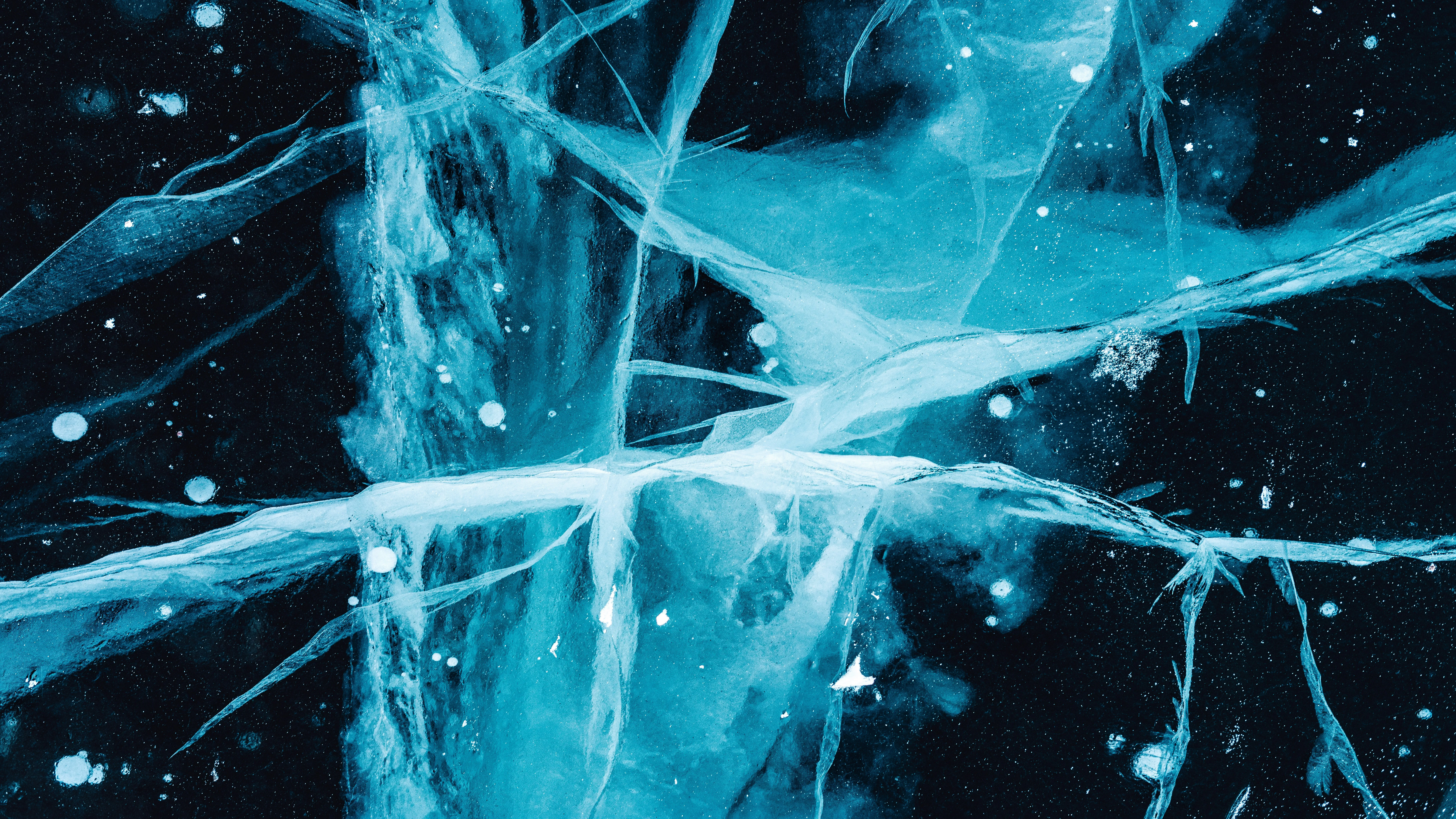
Kinetic & Structural Phenomena
Beyond the sheet itself there are more forces that shape specific features in freshwater environments: hydraulic pressure, wind, and biology.
| Type | Formation | Look |
|---|---|---|
| Lake Stars | Heavy snow depresses the ice and forcing water up through a hole. It spreads radially through the snow cover. | Starburst patterns of frozen slush radiating from a central point. |
| Ice Shoves | High winds drive free-floating ice sheets onto the shore where its bulldozing the terrain. | Walls of fractured ice (up to 12m high) accumulated along the shoreline. |
| Methane Bubbles | Organic decomposition releases gas. As the ice thickens downward it captures rising bubbles. | Vertical stacks of white disks suspended in clear, black ice. |